
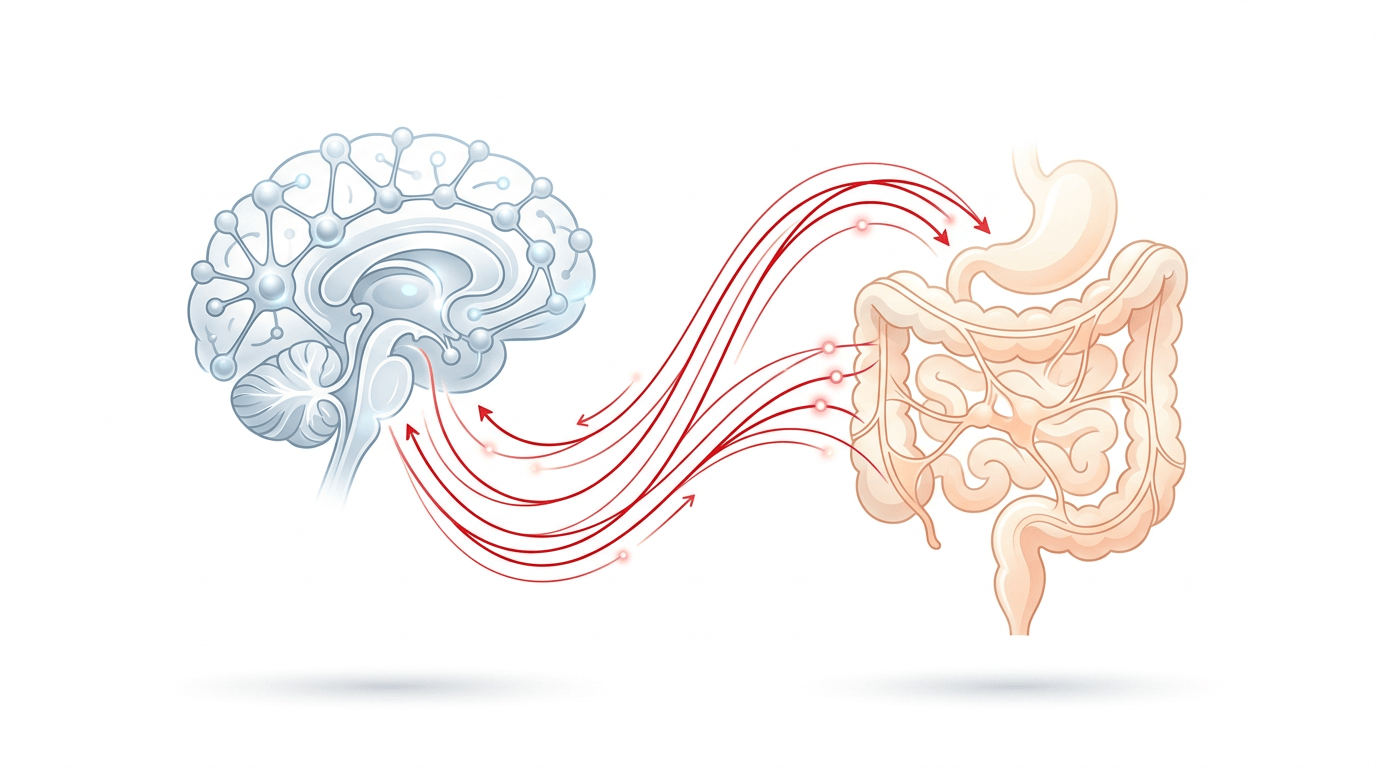
The Gut-Brain Axis: Why Your Microbiome Is Your Second Nervous System
The enteric nervous system in your gut contains more neurons than your spinal cord. The microbial community living there communicates directly with your brain. This is not a metaphor.
The Gut as a Nervous System
The gastrointestinal tract contains approximately 500 million neurons — more than the entire spinal cord, and more than any other organ outside the brain itself. This neural network, called the enteric nervous system (ENS), operates with substantial autonomy from the central nervous system. It regulates digestion, coordinates gut motility, manages immune responses in the intestinal lining, and maintains the integrity of the gut barrier.
The ENS is connected to the brain via the vagus nerve — a bidirectional communication highway that runs from the brainstem to the abdomen. Signals travel in both directions. The brain sends instructions to the gut. The gut sends signals back to the brain.
What received considerably less attention until recently is that the ENS does not operate in isolation. It is embedded in an ecosystem of approximately 38 trillion microorganisms — bacteria, archaea, fungi, and viruses — collectively called the gut microbiome. This community of organisms communicates with the ENS, the immune system, and directly with the brain in ways that are reshaping fundamental understanding of neurology, psychiatry, and systemic medicine.
The Neurotransmitter Connection
Approximately 95% of the body's serotonin is produced in the gut — not the brain.
Serotonin is typically characterized as a brain neurotransmitter associated with mood regulation. But its primary site of synthesis is the enterochromaffin cells of the intestinal lining, where it coordinates gut motility and communicates with the ENS.
The gut microbiome directly influences serotonin production. Certain bacterial strains — including Lactobacillus rhamnosus, Bifidobacterium longum, and several Clostridium species — stimulate enterochromaffin cells to produce more serotonin. Others suppress production. The net serotonin output of the gut is therefore a function of microbial community composition.
Because gut serotonin communicates with the brain via the vagus nerve, the microbiome's influence on serotonin production is also, indirectly, an influence on mood, stress response, and cognitive function.
The research implications are significant. A 2019 meta-analysis in General Psychiatry found that probiotic supplementation produced measurable improvements in anxiety and depression scores compared to placebo — an effect that the researchers attributed primarily to microbiome-mediated modulation of the gut-brain axis rather than any direct central mechanism.
GABA, Dopamine, and the Microbial Neurotransmitter Factory
Serotonin is not the only neurotransmitter with gut-microbiome connections.
GABA (gamma-aminobutyric acid) — the primary inhibitory neurotransmitter in the central nervous system, responsible for dampening neural excitability and reducing anxiety — is produced by several gut bacterial species, including Lactobacillus rhamnosus and Bifidobacterium dentium. In germ-free animal models (animals raised without any gut microbiome), GABA receptor expression in the brain is significantly altered compared to animals with normal microbiomes.
Dopamine precursors. Certain gut bacteria produce or convert amino acids into dopamine precursors, including L-DOPA (3,4-dihydroxy-L-phenylalanine). The relevance to neurological conditions — including Parkinson's disease, which involves dopaminergic neuron loss — is an active area of investigation.
Short-chain fatty acids (SCFAs). When gut bacteria ferment dietary fiber, they produce butyrate, propionate, and acetate. These molecules cross the blood-brain barrier and directly influence neural function, neuroinflammation, and the health of myelin sheaths (the protective coating of neurons). Butyrate in particular has been associated with improved cognitive function and reduced neuroinflammation in animal studies.
The Gut Barrier: When the Wall Fails
The gut's relationship with the brain is mediated not just through chemical signals, but through the integrity of the gut barrier itself.
The intestinal lining is a single layer of epithelial cells, connected by tight junction proteins, that serves as a selective barrier between the gut interior (which contains enormous quantities of potentially inflammatory material) and the systemic circulation. When this barrier is intact, it allows nutrients and beneficial compounds to pass while blocking pathogens and endotoxins.
Certain conditions — dysbiosis (microbial imbalance), chronic stress, antibiotic use, processed food diets, and aging — can compromise tight junction integrity. The result is a condition colloquially called "leaky gut" — technically, increased intestinal permeability.
When the gut barrier is compromised, bacterial endotoxins (specifically lipopolysaccharides, or LPS) can enter the bloodstream. LPS is a potent trigger of the innate immune system. The systemic low-grade inflammation that follows has been implicated in depression, anxiety, cognitive decline, and a range of metabolic and autoimmune conditions.
Maintaining gut barrier integrity is therefore not just a digestive concern — it is a neurological and systemic health concern.
What Makes a Probiotic Actually Work
The probiotic supplement market is characterized by significant variation in product quality and a corresponding variation in clinical outcomes. Not all probiotic products are created equal. Several factors determine whether a probiotic formula produces meaningful gut-brain axis effects:
Strain specificity. Different bacterial strains have different biological effects. L. rhamnosus JB-1 has been specifically studied for gut-brain axis effects. B. longum strains have demonstrated anti-anxiety effects in clinical trials. Generic "Lactobacillus" formulas without strain specification may contain completely different bacteria than those studied in the literature.
CFU delivery. Colony-forming units (CFU) — the measure of live bacteria — must be delivered in clinically relevant quantities to the colon. Most bacteria do not survive the acid environment of the stomach. The published literature on gut-brain axis effects typically uses doses of several billion CFU or more.
Encapsulation technology. The barrier between supplemented probiotic bacteria and their functional destination is stomach acid, bile, and digestive enzymes. Without protection from these environments, most supplemented bacteria are destroyed before reaching the colon. Multi-layer encapsulation technology is the current standard for ensuring viable delivery.
Prebiotic support. Probiotic bacteria require substrates to ferment. Without prebiotic fibers, supplemented strains may fail to establish in the existing microbiome.
The ABTIDE Probiotic Architecture
ABTIDE's probiotic formulas were designed around the clinical requirements for meaningful gut-brain axis impact:
42 scientifically selected strains. Each strain included in the ABTIDE formula was selected based on published evidence for specific mechanisms — gut barrier maintenance, neurotransmitter precursor production, immune modulation, or competitive exclusion of pathogenic species.
6-layer encapsulation. Six distinct protective layers guarantee survival through the gastric environment. CFU counts printed on ABTIDE labels reflect viable organisms at the colon — not organisms at manufacture, which is the less meaningful (but more commonly reported) figure.
6 Trillion CFU. Delivering at the threshold where clinical evidence for gut-brain axis effects becomes robust.
The gut is not passive plumbing. It is an active participant in your neurological and systemic health — and the microbial community it houses is a lever that nutrition science is only beginning to understand how to pull effectively.
ABTIDE Wellness — Precision Nutrition Backed by Science. Developed in Vancouver, Canada.