
Ergothioneine and Exercise Recovery: ROS Windows, Muscle OCTN1, and the EAA Stack
Exercise recovery is not only glycogen and sleep. It is also managing the oxidative and proteolytic aftermath of training — without smothering the adaptive signals that make training work.
Exercise ROS Comes in Time Windows
Contracting muscle increases oxygen flux through mitochondria. The result is a rise in reactive oxygen species (ROS) during and after hard sessions. ROS are not purely villains: redox signals help drive mitochondrial biogenesis, antioxidant enzyme expression, and training adaptations.
The practical tension for athletes and active adults:
- Too little antioxidant capacity → excess oxidative damage to lipids, proteins, and mitochondria; slower quality recovery
- Too much, timed poorly (especially chronic high-dose vitamin C/E around training in some study designs) → potential blunting of adaptation signals
The goal of precision recovery nutrition is support — not sterilization of every free radical.
OCTN1 in Muscle: Why Ergothioneine Is Different
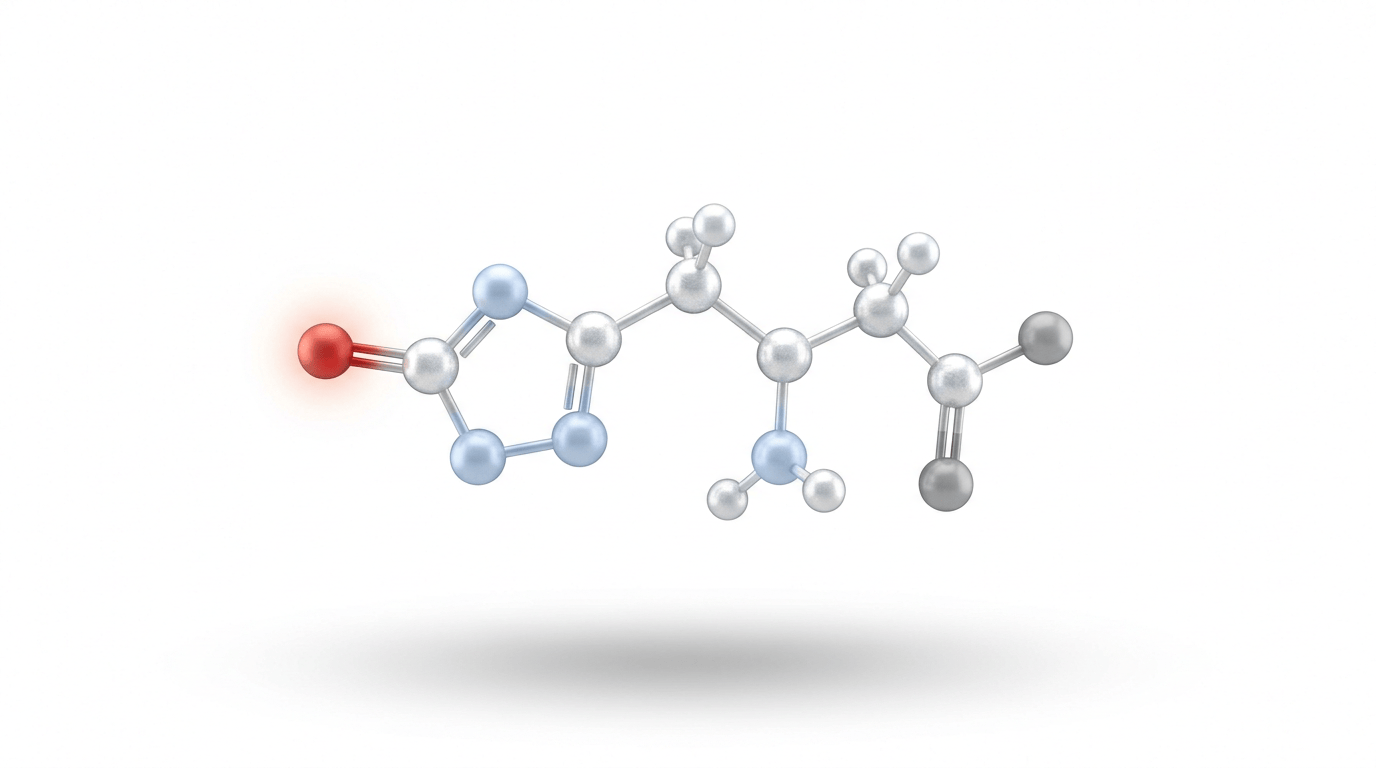
L-ergothioneine is imported by the organic cation transporter OCTN1 / ERGT1 (SLC22A4). Foundational work characterizing this transporter established its high specificity for ergothioneine (Gründemann et al., 2005, Proceedings of the National Academy of Sciences).
Expression of OCTN1 in tissues with high metabolic demand — including muscle — means ergothioneine can be concentrated where oxidative pressure is routine. Once inside cells, it tends to associate with compartments under stress, including mitochondria.
Compare that with common antioxidant vitamins:
| Feature | Ergothioneine | Vitamin C | Vitamin E |
|---|---|---|---|
| Primary localization logic | OCTN1-mediated tissue uptake; long retention | Aqueous compartments; rapid turnover | Lipid membranes |
| Retention | Extended tissue half-life | Hours-scale clearance | Membrane-dependent |
| Adaptation concern | Generally discussed as cellular reservoir support | High chronic doses sometimes debated re: training signals | Same caution in some endurance literature |
Structure/function claim: ergothioneine supports cellular antioxidant capacity in tissues that express OCTN1. It is not a treatment for rhabdomyolysis, overtraining syndrome, or any medical condition.
For the longevity and transporter primer, see ergothioneine cellular protection. Research framing for ABTIDE’s ergothioneine work lives at ergothioneine research.
Pairing With Essential Amino Acids
Oxidative balance is only half of recovery. Training breaks down muscle proteins; rebuilding them requires essential amino acids and an intact MPS signal.
A coherent stack:
- Free-form EAAs around training to deliver a rapid leucine-inclusive EAA pulse for muscle protein synthesis (absorption mechanics)
- Ergothioneine as a longer-retention antioxidant reservoir for mitochondrial and cellular redox support
- Sleep, carbohydrate as needed, and progressive programming — still the largest effect sizes
Browse amino products and ergothioneine products if you are mapping these levers to formulas — then let training load and clinician advice set total context.
What Not to Invent From Marketing
Sports-supplement marketing often invents unpublished “recovery percentages” or unpublished trial numbers. This article deliberately avoids inventing efficacy statistics. Mechanistic rationale (OCTN1 specificity, ROS biology, EAA-driven MPS) is sufficient to justify a careful stack; manufactured percentages are not.
If a brand cannot point to a real citation for a numeric claim, treat the number as decoration.
Practical Use Notes
- Ergothioneine’s long retention means daily consistency matters more than panic dosing only on hard days
- EAAs are more timing-sensitive around the training bout
- Do not megadose antioxidant vitamins solely because a session felt hard
- Hydration, energy availability, and soft-tissue load management still dominate outcomes
Hard sessions elevate ROS; easy sessions and deload weeks do not require a different “antioxidant protocol.” Think in terms of a stable cellular reservoir (ergothioneine) plus bout-timed amino acid support (EAAs), layered on programming that actually allows recovery. If soreness, performance drop, or resting heart-rate elevation persist despite nutrition basics, the limiting factor is usually training load, sleep, or illness — not a missing capsule.
Endurance and strength athletes can use the same stack logic with different carbohydrate and total-energy contexts. The redox and EAA principles do not change; the fueling does.
These statements have not been evaluated by the Food and Drug Administration. This product is not intended to diagnose, treat, cure, or prevent any disease.
ABTIDE Wellness — Vancouver. Educational content only.
Reference
- Gründemann D, et al. Discovery of the ergothioneine transporter. Proc Natl Acad Sci USA. 2005;102(14):5256–5261.