
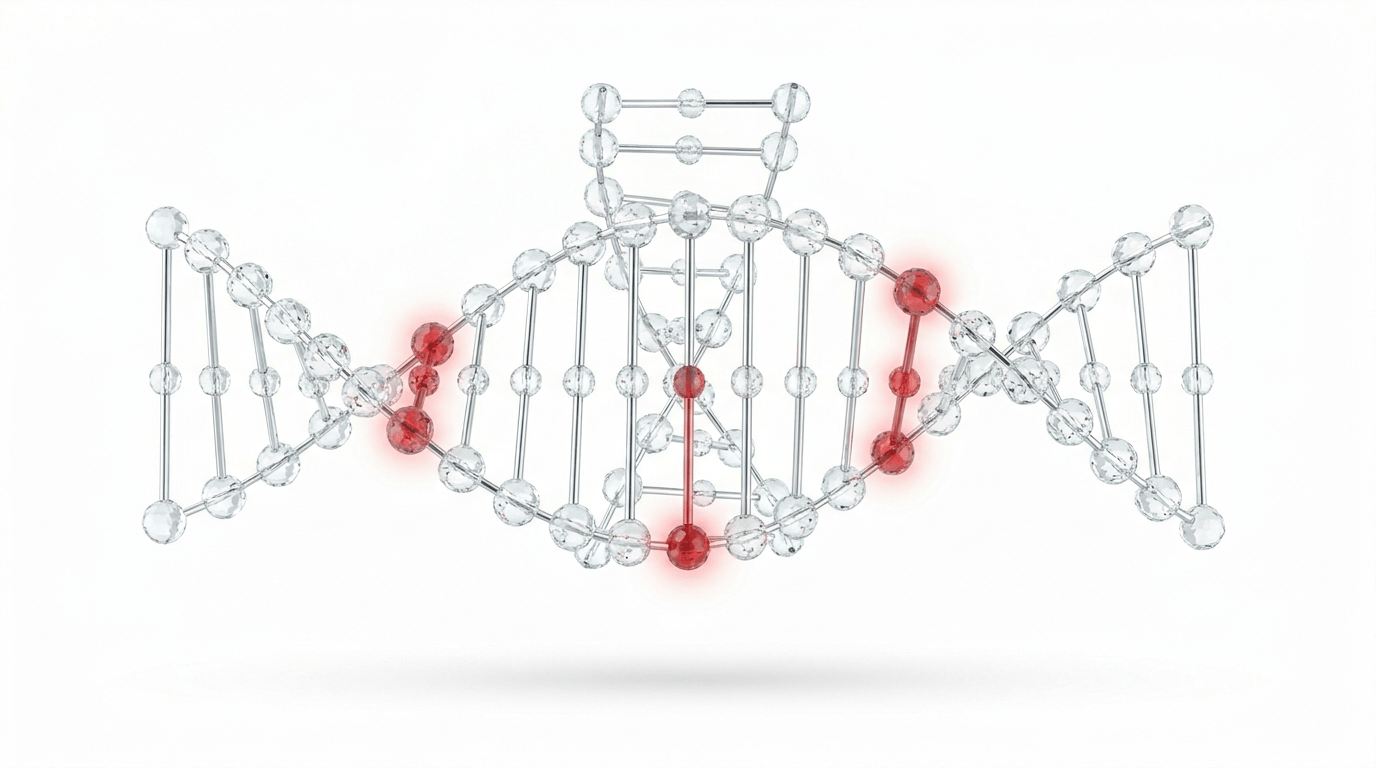
Epigenetic Aging: Your Biological Age Is Not Your Chronological Age
DNA methylation patterns determine how your cells age — independent of time. Understanding this mechanism is the foundation of modern longevity science.
Two Clocks, One Body
You have two ages. The first is chronological — the number of years since you were born. This clock moves at a fixed rate for everyone and cannot be altered.
The second is biological — the functional age of your cells, tissues, and organs, as measured by molecular markers within your DNA. This clock does not move at a fixed rate. It accelerates and decelerates based on your environment, your diet, your stress levels, your sleep, and — increasingly — your nutritional choices.
The gap between these two numbers is one of the most clinically significant measurements in modern medicine. A 50-year-old with a biological age of 42 is not just younger-feeling. They have measurably different disease risk, cognitive function, and physical capacity than a 50-year-old with a biological age of 60.
The mechanism that determines biological age is called epigenetic methylation.
What Is DNA Methylation?
Your genome contains approximately 3 billion base pairs encoding roughly 20,000 genes. But not all genes are active at any given time. Gene expression — which genes are turned on, which are turned off, and at what intensity — is controlled by a layer of chemical modifications that sit on top of the DNA sequence itself.
This regulatory layer is the epigenome.
DNA methylation is the most well-studied epigenetic mechanism. It involves the attachment of a methyl group (a carbon atom bonded to three hydrogen atoms) to specific cytosine bases in the DNA — particularly at sites called CpG dinucleotides. When a gene's promoter region becomes methylated, that gene is typically silenced. When it is demethylated, the gene becomes accessible for transcription.
What makes methylation relevant to aging is this: methylation patterns change predictably with age. Some sites that were methylated in youth become demethylated in aging cells. Other sites that were unmethylated become methylated. The accumulation of these changes — across thousands of CpG sites — constitutes what scientists call an epigenetic clock.
The Epigenetic Clocks
In 2013, a UCLA biostatistician named Steve Horvath published a landmark paper identifying 353 CpG methylation sites whose combined methylation pattern could predict a person's chronological age with remarkable precision — typically within 3.6 years — across multiple tissue types and individuals.
This became known as the Horvath Clock. It was the first demonstration that a molecular signature could function as a reliable biological age indicator.
Since then, several additional epigenetic clocks have been developed:
GrimAge — Developed by Horvath and colleagues, GrimAge predicts lifespan and healthspan. Studies suggest that GrimAge acceleration (biological age running faster than chronological age) is a stronger predictor of all-cause mortality than many traditional risk factors.
PhenoAge — Developed at the National Institute on Aging, PhenoAge was trained on clinical biomarkers and provides an integrated measure of physiological aging that correlates with disease risk.
DunedinPACE — A more recent clock that measures the rate of aging rather than current biological age, allowing real-time monitoring of whether interventions are slowing or accelerating the aging process.
The consistency across these different methodologies provides strong evidence that the aging process is reflected in — and potentially driven by — methylation dynamics.
The Methyl Donor Pathway
If methylation patterns are central to biological aging, the obvious question is: what controls methylation?
The answer lies in a biochemical pathway called the one-carbon metabolism cycle — specifically, the supply of methyl donors and the enzymes that transfer them to DNA.
The primary methyl donor in human cells is S-adenosylmethionine (SAM). SAM is synthesized from the amino acid methionine through a series of enzymatic reactions. After donating a methyl group to DNA (or another substrate), SAM becomes S-adenosylhomocysteine, which is then converted to homocysteine.
Homocysteine can be recycled back to methionine through two pathways:
- The folate pathway — requiring methylfolate and vitamin B12
- The betaine pathway — using betaine (trimethylglycine, or TMG) as the methyl donor
The efficiency of this recycling determines how much SAM is available for DNA methylation. When the pathway is impaired — through nutrient deficiency, genetic variants in key enzymes, or aging-related declines in enzymatic activity — methylation capacity is compromised.
The downstream consequence is exactly what is observed in aging cells: progressive loss of methylation at sites that should remain methylated, and inappropriate methylation at sites that should remain open.
Key Nutrients in the Methylation Pathway
Several nutrients are directly involved in maintaining methylation capacity:
Methylfolate (5-MTHF). The active form of folate, directly required for the remethylation of homocysteine. Approximately 40% of the population carries variants in the MTHFR gene that impair their ability to convert dietary folate to methylfolate — making active-form supplementation particularly relevant for this group.
Vitamin B12 (methylcobalamin). Works alongside methylfolate in the folate-dependent remethylation pathway. B12 deficiency rapidly impairs methylation and raises homocysteine.
Betaine (TMG). The alternative remethylation substrate that bypasses the folate pathway entirely. Particularly relevant when folate metabolism is compromised or when rapid methylation demand requires additional capacity.
Choline. A precursor to betaine and an independent methyl donor. Choline deficiency has been associated with DNA hypomethylation in animal models.
Riboflavin (B2). Required as a cofactor for MTHFR enzyme activity. Riboflavin status modulates the impact of MTHFR genetic variants on methylation capacity.
What You Can Measure
Biological age testing based on DNA methylation is now commercially available. Several consumer and clinical services offer methylation-based age testing from a blood or saliva sample. These tests provide a snapshot of your current epigenetic clock status and — with repeat testing over time — allow monitoring of whether your biological age is improving or worsening.
The interpretation framework is straightforward: if your biological age is running younger than your chronological age, your cellular aging is occurring at a below-average rate. If it is running older, interventions to support methylation capacity and reduce oxidative burden are indicated.
The ABTIDE Connection
ABTIDE's ergothioneine formulas address the oxidative side of the equation — protecting DNA and mitochondria from the free radical damage that disrupts methylation machinery and accelerates epigenetic aging.
The E9 Ultra formula addresses the methyl donor pathway directly, combining betaine TMG with NAC and L-carnitine — supporting the biochemical infrastructure that maintains methylation fidelity across the aging process.
Biological age is not fixed. The mechanisms that determine it are biochemical, and biochemistry responds to nutritional inputs.
ABTIDE Wellness — Precision Nutrition Backed by Science. Developed in Vancouver, Canada.