Collagen Synthesis, Explained: Amino Acids, Vitamin C, and Why Peptides Are Not Magic
Collagen is the body’s most abundant protein — roughly 25–30% of total protein mass. That does not mean swallowing collagen peptides automatically rebuilds skin or cartilage. The rate-limiting biology is endogenous synthesis, enzymatic hydroxylation, and how fast you degrade what you already have.
The Molecular Scaffold
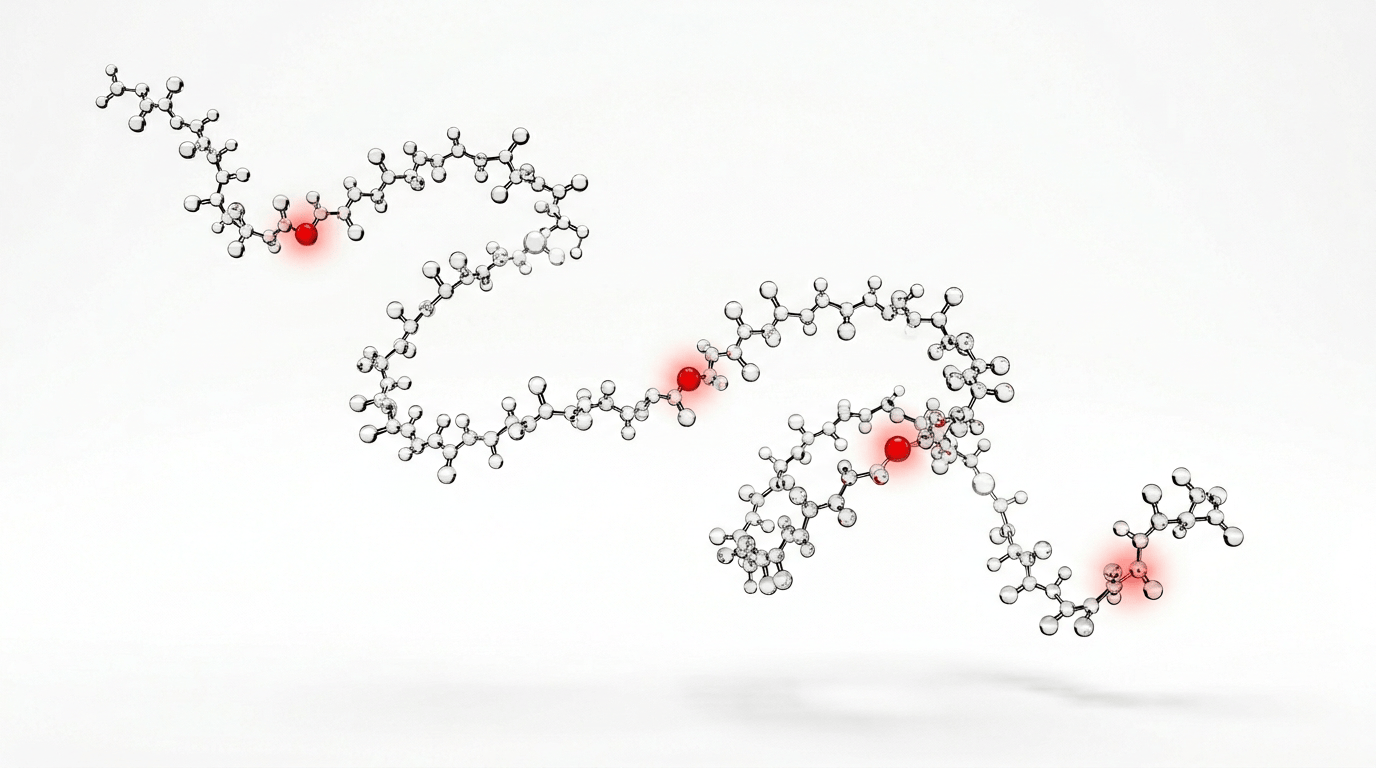
A collagen molecule is a triple helix of three α-chains. Each chain is rich in the repeating Gly-X-Y motif (glycine–X–Y), where X is often proline and Y is often hydroxyproline.
- Glycine (~33%): the smallest amino acid; packs inside the triple helix. Every third residue must be glycine for the helix to form.
- Proline (~10–12%): stiffens the chain and stabilizes helical geometry.
- Hydroxyproline (~9–10%): formed post-translationally from proline; critical for thermal stability of the helix.
Among ~28 collagen types, everyday nutrition conversations usually mean:
| Type | Primary tissues | Role |
|---|---|---|
| I | Skin, bone, tendon, ligament | Tensile strength (~90% of body collagen) |
| II | Cartilage, vitreous | Compressive resilience |
| III | Skin, vessels, viscera | Elastic networks |
How the Body Builds Collagen (and Where It Breaks)
Collagen biosynthesis is one of the most heavily post-translationally modified protein pathways in human biology:
- Transcription/translation in fibroblasts, osteoblasts, or chondrocytes under growth-factor signals (TGF-β, IGF-1).
- Hydroxylation (rate-limiting): prolyl-4-hydroxylase converts proline → 4-hydroxyproline; lysyl hydroxylase modifies lysine. Both enzymes require Fe²⁺ and vitamin C.
- Glycosylation and triple-helix assembly from C- to N-terminus.
- Secretion and propeptide cleavage to mature collagen.
- Crosslinking via lysyl oxidase (LOX) to form insoluble fibers that give tissues mechanical strength.
Vitamin C is not optional window dressing
Without vitamin C, Fe²⁺ cofactor recycling fails, hydroxylation stalls, and improperly formed α-chains are degraded intracellularly. Classic scurvy is the clinical extreme of this molecular failure — impaired wound healing and connective-tissue fragility. Daily intakes around 100–200 mg typically support normal collagen hydroxylation; smoking and high oxidative stress raise requirements.
Iron deficiency can likewise impair hydroxylation because Fe²⁺ is a required cofactor.
These statements describe nutritional biochemistry. They are not intended to diagnose, treat, cure, or prevent any disease.
Why Collagen Declines With Age
After ~age 25, dermal collagen synthesis declines on the order of ~1% per year in many estimates. Drivers include:
- Lower TGF-β / IGF-1 signaling
- Fibroblast senescence and reduced proliferative capacity
- Mitochondrial ATP shortfalls for protein synthesis
- Oxidative stress damaging collagen gene expression and modifying enzymes
Degradation accelerates via matrix metalloproteinases (MMPs). UV exposure activates AP-1/NF-κB → MMP-1 upregulation → cleavage of type I/III collagen. Glycation forms AGEs that stiffen fibers. Chronic inflammatory cytokines (IL-1β, TNF-α) further upregulate MMPs while dampening TGF-β signaling.
Oral Collagen Peptides: What the Evidence Actually Says
After digestion, oral collagen appears in blood largely as free amino acids and characteristic dipeptides such as Pro-Hyp, with plasma peaks ~1–2 hours after a ~10 g dose in classic tracer work (Iwai et al., 2005, Journal of Agricultural and Food Chemistry).
A systematic review of dermatological applications reported improvements in skin elasticity and hydration across multiple RCTs, with effect sizes in the moderate range and frequent industry funding (Choi et al., Journal of Drugs in Dermatology / related Nutrients reviews). Joint outcomes (e.g., WOMAC pain scores) exist in smaller RCTs but sit below the evidence base for some other joint-support nutrients.
Important nuance: hydroxyproline released by digestion is not simply “reused as hydroxyproline” for new collagen — the body must re-hydroxylate proline during synthesis. Collagen peptides supply glycine/proline-rich substrate; they do not bypass the enzymatic pathway.
Collagen Peptides vs Complete Essential Amino Acids
| Dimension | Collagen peptides | Complete free-form EAAs |
|---|---|---|
| Amino acid completeness | Incomplete (notably low tryptophan) | All 9 EAAs |
| Glycine / proline | High (signature advantage) | Balanced |
| Leucine (MPS trigger) | Low (~1.5%) | Can be dosed to threshold |
| Digestion required | Yes → peptides/amino acids | Minimal (free-form) |
| Best use case | Skin/joint substrate support | Whole-body protein synthesis |
Precision takeaway: if the goal is structural collagen support, peptides can be one substrate option — but pairing with vitamin C and a complete EAA profile is more coherent than peptides alone. Free-form EAAs also matter for adults over 50 facing anabolic resistance (free-form absorption mechanics; amino research overview).
A Mechanism-Aligned Support Framework
Without overselling any single ingredient:
- Substrate: glycine/proline-rich intake + complete EAAs for MPS
- Cofactors: vitamin C (and adequate iron status)
- Protect synthesis capacity: mitochondrial antioxidant support (e.g., ergothioneine) to limit ROS-driven fibroblast stress
- Slow degradation: anti-inflammatory dietary patterns; Omega-3 phospholipids; gut-immune calm that reduces systemic cytokine load on MMPs
ABTIDE’s amino, ergothioneine, probiotic, and essential lines map to these levers — food quality and sun protection still do the heavy lifting.
FAQ
Do pig trotters / fish skin “replace” supplements? They contain collagen, but digestion still yields amino acids/peptides — with substantial saturated fat in many traditional dishes. Targeted peptides or EAAs are simply more dose-efficient.
Must vitamin C be taken with collagen? Hydroxylase biology says vitamin C adequacy is required for synthesis. Pairing is rational; it is not a marketing gimmick.
Are collagen peptides a scam? Evidence supports modest skin/joint benefits in some trials. They are neither magic nor worthless — they are incomplete substrate. Complete EAAs + vitamin C + degradation control is the more complete story.
Can vegetarians support collagen synthesis? Yes via plant proteins for lysine/proline precursors, plus attention to leucine, vitamin C, and iron. Free-form EAA formulas can fill gaps when plant leucine is low.
References
- Iwai K, et al. Identification of food-derived collagen peptides in human blood after oral ingestion of gelatin hydrolysates. J Agric Food Chem. 2005;53(16):6531–6536.
- Choi FD, et al. Oral Collagen Supplementation: A Systematic Review of Dermatological Applications. J Drugs Dermatol. 2019;18(1):9–16.
- Proksch E, et al. Oral supplementation of specific collagen peptides… Skin Pharmacol Physiol. 2014;27(1):47–55.
- Shoulders MD, Raines RT. Collagen structure and stability. Annual Review of Biochemistry. 2009;78:929–958.
- Pullar JM, Carr AC, Vissers MCM. The roles of vitamin C in skin health. Nutrients. 2017;9(8):866.
ABTIDE Wellness — Vancouver. Educational content only. Dietary supplements are not intended to diagnose, treat, cure, or prevent any disease.